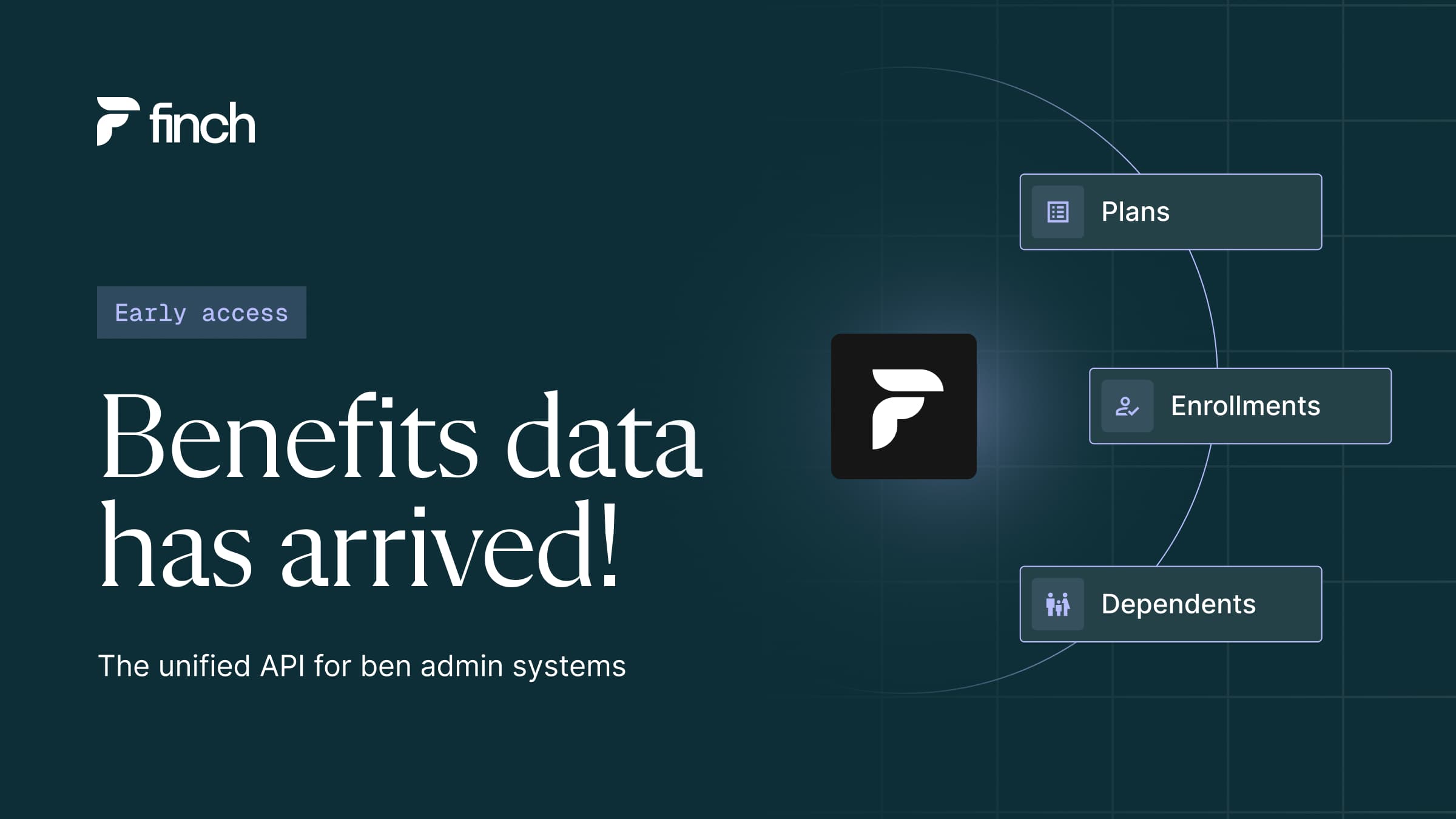
Today we're announcing the launch of our newest product: Finch Benefits, now available in Early Access.
Benefits extends Finch’s coverage of 250+ payroll and HR systems to include benefits administration, giving insurance carriers, third-party administrators, and benefits technology platforms programmatic access to employee enrollment data like plans, enrollments, and dependents.
Enrollment data is the input almost every benefits workflow depends on, from verifying eligibility to underwriting coverage. Today it moves through old, manual data plumbing, which leaves the entire benefits ecosystem to make decisions against records that are often weeks out of date. API integrations move data in real time or close to it, but building dozens or hundreds of them, one provider at a time, can cost millions and take years. With a single API, these operators can replace those manual feeds with one employer-authorized connection.
Every carrier, TPA, and benefits platform we work with is looking for a faster way to onboard clients and act on their data before it goes stale. What we're doing at Finch — combining benefits enrollment with the payroll coverage they already trust us for — is the closest this industry has come to a single source of truth for employment data.
Benefits is available today for ADP Workforce Now and Workday, with more providers arriving through the 2027 Open Enrollment season.
In this video, Product Manager Lauren Wan walks through a demo of Finch Benefits.
The first API to unify payroll and benefits data
Finch Benefits makes us the first unified API to read benefits enrollment data and write deductions and contributions back to payroll. Those two halves have historically lived in separate systems connected by file feeds. With one connection, a platform can surface an employee's coverage, verify their dependents, and adjust the paycheck line item that funds their plan.
Programmatic access to benefits administration data has been one of the most consistent requests we've received from customers. We've always wanted to power benefits workflows end to end, and we built our product to do that in a very intentional order, starting with payroll.
Administering most workplace benefits, whether it's a group health insurance plan or an FSA, takes three things at once. You need to know who the employees are. You need to be able to make the appropriate deductions from their paychecks. And you need to keep tabs on what benefits they've enrolled in, and whether that coverage extends to any dependents.
So we started with read access to company directories and pay statements, then quickly expanded into deductions. Benefits workflows fundamentally require reading data from and writing data to the payroll system, and that's what we've enabled for years: the payroll side. Now we’ve closed the loop with read access to the other half of that data: the detailed plans an employer offers, who has enrolled in them, and whether that benefit extends to anyone else.
The evolution from disconnected file feeds to programmatic, fresh data access matters in categories like insurance, where connectivity is now a key driver for deals. Sherri Bycroft, Director – Benefits Technology Relationships at Prudential Financial, told my co-founder Ansel as much just a few weeks ago on The Current:
"We've heard from our top sales executives that it's not the rates that sell our coverage or even our products anymore. There's not that much differentiation. Life insurance and disability coverage, those things are somewhat standard. So it's really who can connect, who can do it well, who can exchange their data and make it smooth and easy for their HR team."
A milestone in the Finch mission
Our mission is to revolutionize employment by building the infrastructure that powers every facet of work.
Workforce data today is scattered across siloed systems that span HRIS, payroll, and ben admin systems, all the way upstream to insurance carriers and banks. That disconnect slows innovation. The future of work depends on scalable technology and workflows powered by a shared network infrastructure.
Finch Benefits is a major step toward creating a single source of truth for employment data, and it's one layer of several. We started by unifying data; now we're unifying the workflows that run on it. Each provider we add through this Open Enrollment season widens what carriers, TPAs, and platforms can actually build. That's the part I'm most excited about.
To request Early Access to Finch Benefits, visit tryfinch.com/product/benefits. You can also read the Benefits API documentation or sign up for the sandbox to explore it yourself.

97% of HR professionals say it’s important for your app to integrate with their employment systems
Learn more in our State of Employment Technology report ->
97% of HR professionals say it’s important for your app to integrate with their employment systems

Payroll Integrations Made for Retirement