Payroll APIs are critical infrastructure for modern ERP systems: they deliver the deep data granularity that these platforms need to power payroll accounting automation and its downstream applications, like automated general ledger reconciliation, cost allocation, and headcount planning. A growing number of AI-native ERP and finance platforms have already put payroll APIs to work, using them to automate workflows that legacy systems still handle manually.
Without a direct API connection, finance teams are stuck exporting files, manually mapping fields, and uploading data every pay cycle. That manual process introduces delays, errors, and a ceiling on what the ERP can actually do with the data.
When payroll data flows in through an API—standardized, granular, and near real-time—it becomes the foundation for a new class of automated workflows. That’s why they’ve quickly become the secret weapon of AI-native ERPs.
Let’s dive into what that looks like in practice.
Real-world examples of payroll APIs powering automated ERP workflows
A new wave of AI-native ERPs is rapidly disrupting the market. By leveraging direct integrations with payroll systems, these modern platforms are delivering intelligent workflow layers that can automate period-end close, flag anomalies, and surface the real-time insights businesses depend on to make decisions.
Below are a few real-world examples of ERP and FP&A systems that are using payroll APIs to power differentiated products and user experiences.
Rillet: Labor, project, and job cost allocation
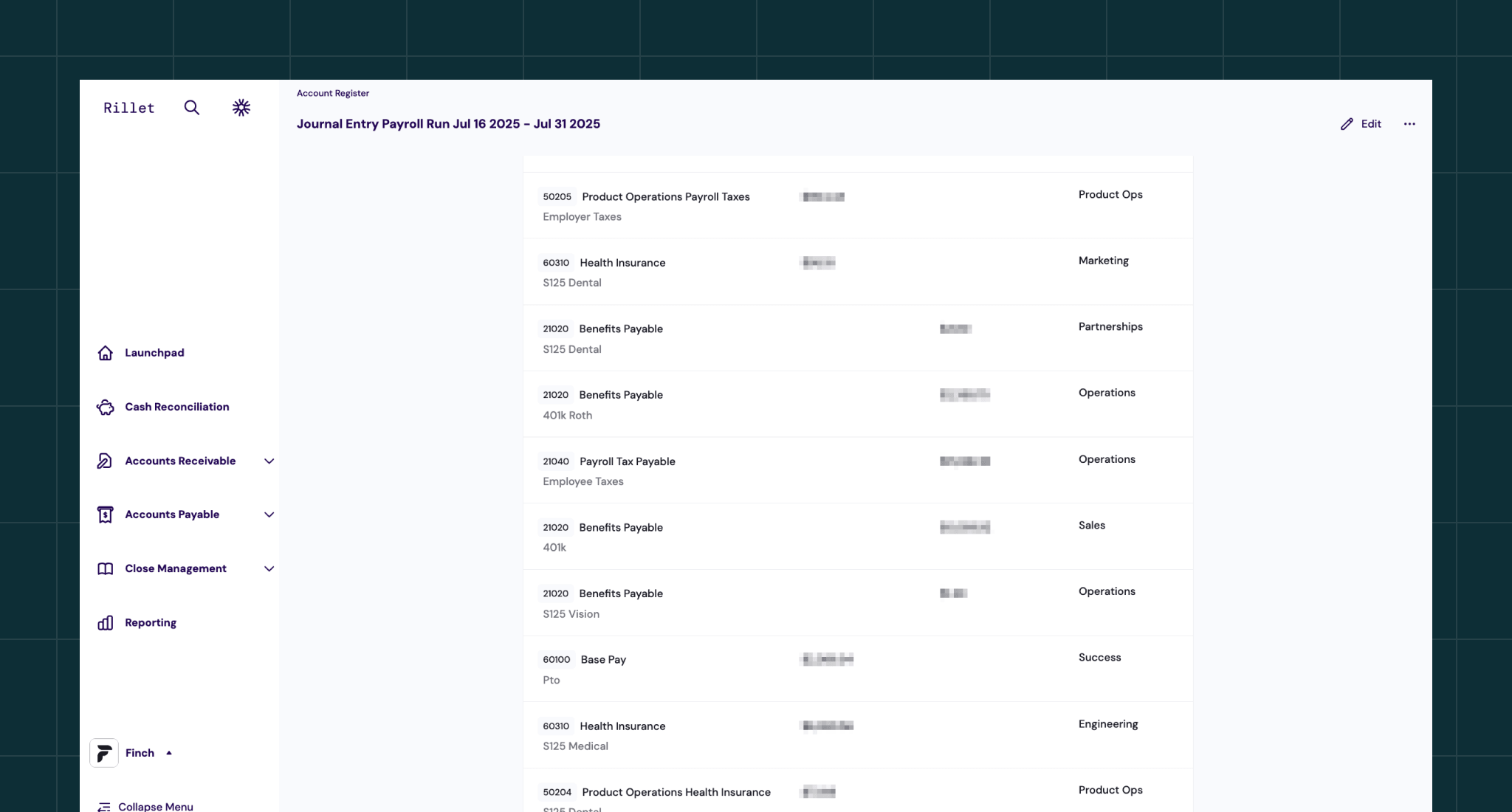
For businesses that need to understand where their labor dollars are going, payroll APIs unlock a level of cost allocation that flat-file imports can’t support.
Rillet, the ERP built intentionally for continuous close, advanced revenue recognition, and multi-entity support, delivers direct insight into labor costs across org-specific functions. With access to organizational dimensions embedded in the payroll data—including department, cost center, and location—Rillet can allocate labor dollars to the relevant business segments automatically. For companies that need to go further, payroll APIs also enable attribution of payroll costs to specific projects, jobs, work orders, or grants. This powers margin reporting and profitability views tied directly to actual labor expenses, rather than estimates or proxy allocations.
Campfire: End-to-end payroll accounting automation
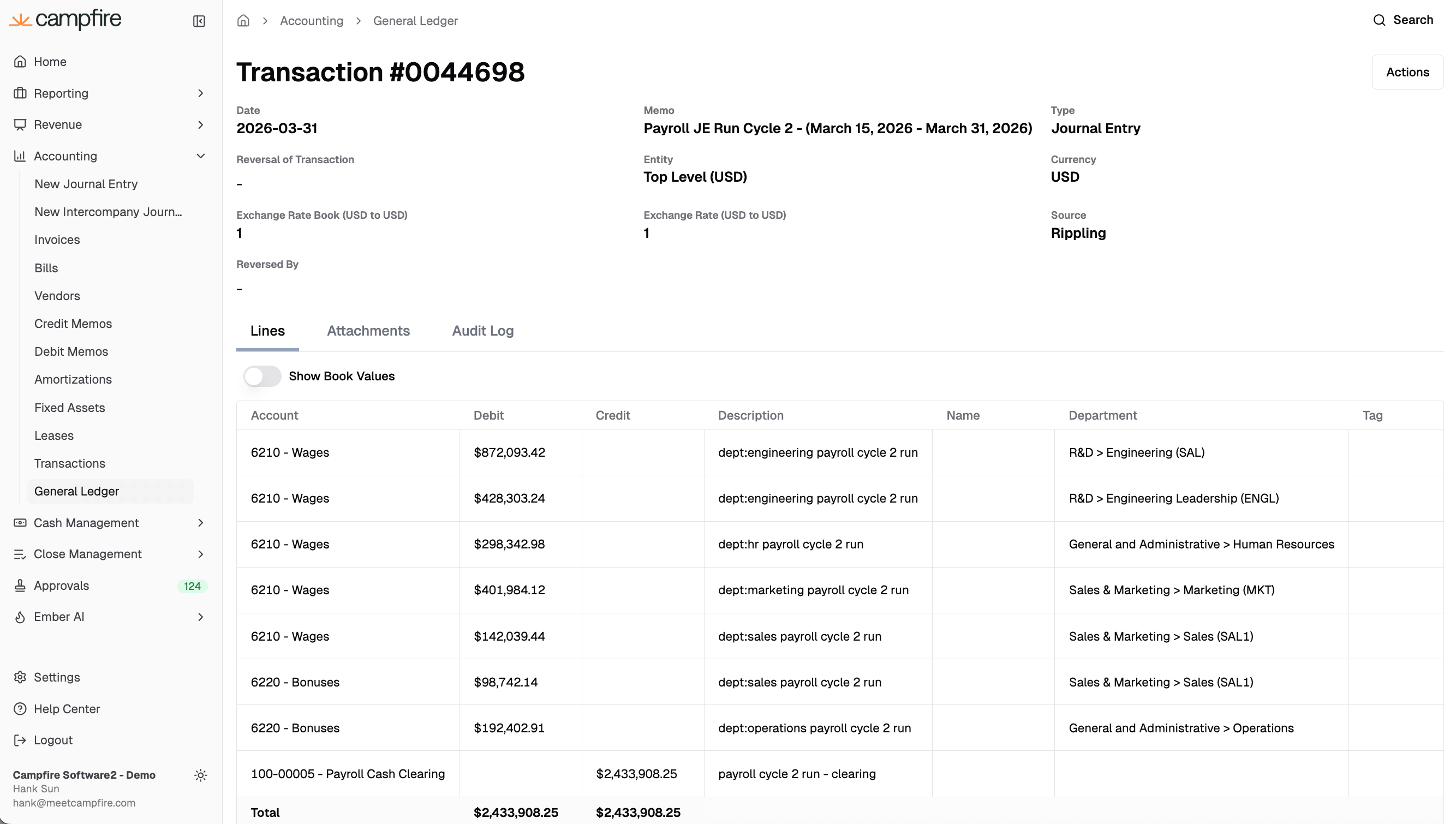
The most immediate use case for payroll integrations in an ERP is automating payroll journal entries. Campfire uses payroll APIs to access individual pay statement line items from their customers’ payroll systems, which means the platform can generate post-ready journal entries at whatever level of detail the customer requires, from a simple departmental roll-up to a fully itemized breakdown of wages, taxes, benefits contributions, and deductions.
This granularity supports consistent processing across both regular and off-cycle payroll runs. It also makes month-end readiness far more achievable: Campfire can accrue payroll expenses when pay periods cross months and estimate unpaid wages, bonuses, commissions, and payroll taxes, all without manual intervention from their customers or their Ops team.
DualEntry: Automated GL reconciliation
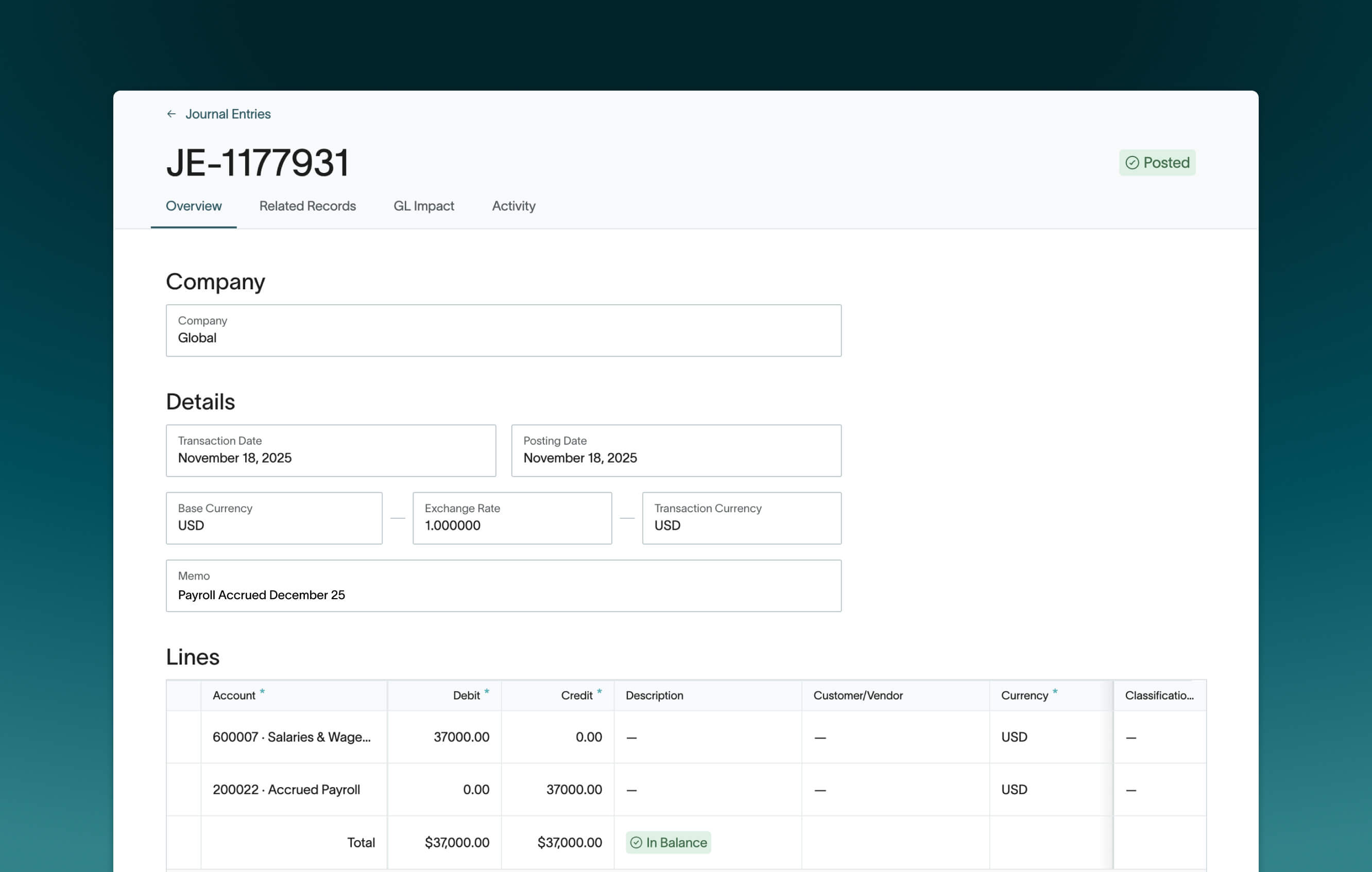
Reconciliation is one of the most time-consuming tasks in a period-end close. When payroll data arrives through an API in a structured, standardized format, it becomes possible to automate much of the work.
DualEntry uses APIs to support continuous reconciliation against payroll registers, bank transactions, and external systems. They can auto-match payroll transactions across sources, flag discrepancies—like payroll expenses that don’t match headcount growth, or tax liabilities that are inconsistent with payroll activity—and surface issues before they become problems at close.
Accurate accruals at period-close also depend on this data. When the payroll cycle spans two reporting periods, DualEntry can project which expenses belong to each period. Clean, line-item payroll data makes that calculation possible without manual estimates.
CandorIQ: FP&A and workforce planning
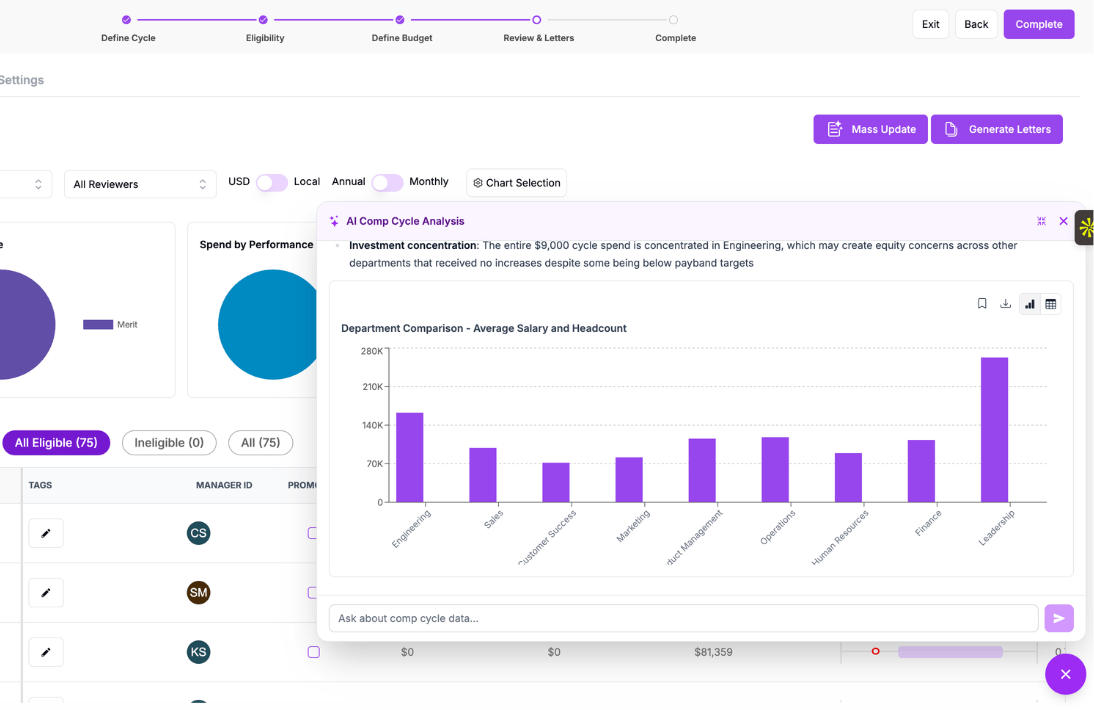
Payroll is more than a backward-looking accounting input—it’s also one of the most critical data sources for forward-looking financial planning. For companies where labor is the largest line item on the P&L, the accuracy of headcount and labor forecasts depends directly on the quality and timeliness of the payroll data feeding them.
Payroll integrations enable CandorIQ to ingest actual compensation, benefits costs, and tax obligations and feed them directly into headcount models and labor forecasts. This improves budget-versus-actual reporting, makes variance analysis more meaningful, and gives finance teams the foundation they need for compensation benchmarking across roles, levels, and geographies.
Why AI-native ERPs are gaining traction
ERP systems used to be static ledgers: places to record what already happened. The new generation of platforms use ERP system integrations to treat financial data as a live input, not a historical artifact. Three shifts explain why these AI-native systems are pulling ahead.
Speed to close. Real-time data access from multiple sources, combined with intelligent automation, is collapsing the time it takes to close the books. Instead of spending days reconciling spreadsheets and chasing down data from disconnected systems, finance teams can focus on analysis and decision-making. When the data arrives automatically and in a structured format, the grunt work disappears.
Better insights and projections. Deeper, more detailed data enables accurate forecasting instead of best-guess estimates. Think month-end accruals that happen mid-payroll cycle, labor dollar allocation broken down by entity, department, and cost center, or headcount planning that reflects actual compensation data rather than approximations. The quality of the insight is directly tied to the granularity of the input.
Improved traceability. Audit trails powered by APIs give modern ERPs something legacy systems can’t easily provide: version control, data lineage, and deterministic replay. When a number changes, the business can quickly and confidently answer who changed it, what upstream data shifted, what logic was applied, and what controls approved it.
Get started with payroll APIs for your ERP
The workflows above deliver measurable results for the platforms and customers that have adopted them. What they all have in common is a foundation of clean, granular, standardized payroll data flowing through a direct API connection. That’s what makes the automation possible, and it’s what separates platforms that can deliver on the promise of AI-native finance from those that are still waiting on manual uploads.
With Finch’s unified API, you can integrate with 250+ HRIS and payroll systems through a single integration, with standardized data and line-item detail that powers the use cases above and whatever you build next. Schedule a call with our team to learn how Finch can power your ERP’s payroll workflows, or sign up to try Finch for free.

97% of HR professionals say it’s important for your app to integrate with their employment systems
Learn more in our State of Employment Technology report ->
97% of HR professionals say it’s important for your app to integrate with their employment systems

Payroll Integrations Made for Retirement