This post is part of Under the Hood, a series from Finch's product team on the real engineering and product challenges behind unifying payroll data at scale.
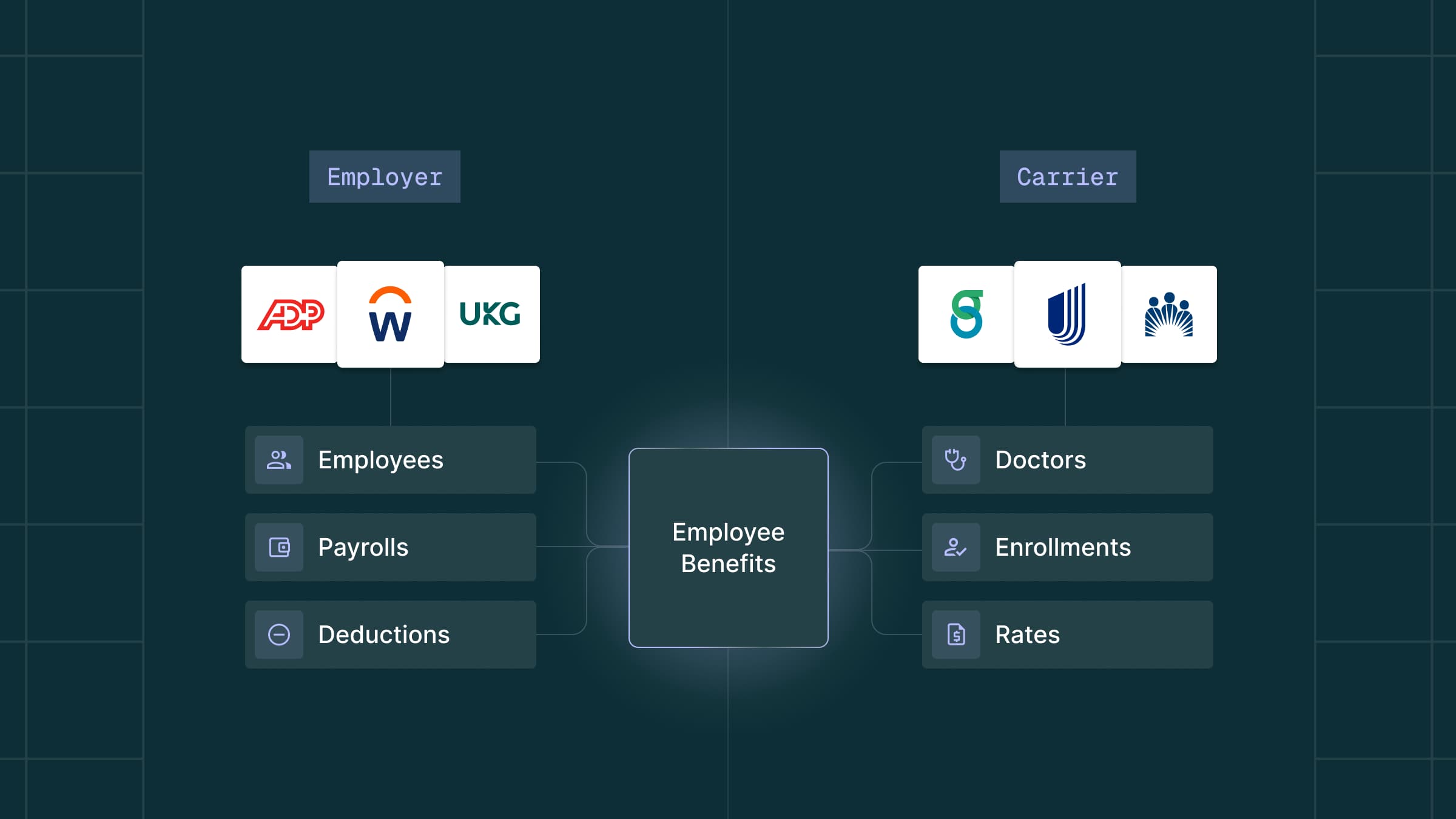
Payroll data is more than information: it’s the fuel that powers thousands of products and services. That data is spread across hundreds of payroll systems, each with its own formatting rules and API (or lack thereof). For any company that powers their product with pay data, this fragmentation isn’t just an engineering nuisance; it’s the single biggest obstacle to building reliable employment software.
If you've ever tried to pull employee data out of a payroll system and into your own product, you know the first integration is deceptively easy. It's the second, tenth, and hundredth that reveal just how fragmented the landscape really is, and how much ongoing work it takes to keep those connections healthy.
Finch was founded on the belief that this data must be more readily available, standardized, and actionable to support the future of work. This conviction has only grown stronger as AI agents—which depend on unfettered access to good data—multiply across the next generation of software applications.
We're addressing this problem by creating a unified data layer that connects the entire employment ecosystem. After years of doing this work across 250+ payroll and HRIS providers, I want to share an honest look at why this problem is so difficult, and why solving it well is so valuable.
Why it matters
Before diving into the problem, it’s worth asking a more fundamental question: why hasn't the industry already solved this?
The reasons are well-documented: ecosystem fragmentation (the U.S. alone has some 660+ payroll softwares), variance in how employers configure their own systems, and deep technical complexity at every layer of the stack.
Taken together, these form a problem of enormous scale, rife with edge cases, regulatory exceptions, and compounding complexity. Critically, none of the players positioned to solve it are incentivized to do so because it’s not a part of their core business value. It's a massive, ongoing infrastructure investment with real compliance risk, and it sits in no one's natural lane.
But when a dedicated platform takes on this work, the downstream benefits are transformative: dramatically faster and more reliable connectivity, an abstraction layer that makes informed decisions, and a foundation of clean data that enables meaningful innovation, including the AI-powered capabilities that will define the next generation of employment software.
Why building payroll integrations is so difficult
When companies first evaluate building payroll integrations, the scope isn't immediately obvious. Connecting to one provider's API feels manageable; but scaling that to dozens or hundreds of providers and keeping those connections reliable over time is an entirely different problem.
Provider fragmentation: No two systems are alike
There is no industry standard for how payroll data is structured. Each has its own schema, field names, and data types.
Take something as seemingly straightforward as FLSA status, the classification that determines whether an employee is exempt or non-exempt under the Fair Labor Standards Act. Gusto uses six different constants for its FLSA field. Paylocity doesn't have a dedicated FLSA field at all; instead, it exposes an "FLSA Overtime Exempt" boolean in its API. Paychex uses yet another convention, centered on overtime exemption.
That’s one field. Multiply it by every field in a payroll system—names, addresses, compensation, employment dates, tax information, benefits enrollments, deduction codes—across hundreds of providers. The fragmentation is enormous, and it scales with every new provider.
Connectivity: Getting connected and staying connected
The fragmentation isn't just in how the data’s structured; it starts with how you access it. Some providers offer well-documented APIs and clear endpoint structures (though many of them require an established marketplace partnership to build to their API, which can involve a lengthy approval process). Others have APIs that are limited in scope, exposing some data but not all of it. And many providers, particularly in the long tail of smaller or legacy systems, don't offer APIs at all.
Even once a connection is established, there’s ongoing maintenance: auth flows break, endpoints are deprecated, and permission models shift. Keeping connections reliable requires continuous monitoring, dedicated on-call engineering, and a team that treats connection health as an ongoing operational discipline rather than a one-time build.
Equally important is ensuring that an employer’s connection stays active once they’ve authorized access. A variety of factors can cause connections to break, from provider-made changes to accountant unlinking. Maximizing the connection lifespan requires proactive monitoring across every provider and catching degradation before it forces an employer into a re-authentication flow.
Data quality and standardization
Even once you're pulling data, the information may be incomplete, inconsistent, or stale. Employers configure their systems differently, leave fields empty, or use custom values.
At Finch, we measure data quality across multiple dimensions: sync error rates, null rates for critical fields, data freshness, and validation accuracy. That kind of granularity matters, because it’s not as simple as a binary “we have the data or we don’t.” It could be an underlying issue in the API, or it could be that the employer hasn’t configured the field. Distinguishing between these cases and communicating them clearly to our customers is part of the product work.
Maintaining data quality at this level requires dedicated SLO monitoring, weekly reviews, automated alerting, and an on-call rotation that can respond to issues before customers notice them.
But accuracy alone isn't enough. Data that is accurate, fresh, and complete can still be unusable if every provider delivers it in a different format. Without standardization, operations teams must manually normalize every data feed or build an internal tool that requires new field mapping for each provider. Finch's unified API abstracts this away, delivering data from every provider in a single standardized format.
Deduction codes and mapping: Where the complexity compounds
Deduction codes are where industry fragmentation becomes most acute. Deductions—401(k) contributions, health insurance premiums, HSA contributions, garnishments, loan repayments—are among the most business-critical and most inconsistently represented data types in payroll.
Take a 401(k) employee contribution, for example: it may be labeled "401K EE" in one system, "RETIRE_PRETAX" in another, and stored as a custom deduction code with an employer-specific name in a third. Our mapping logic has to account for provider-level conventions and employer-level configuration, creating a combinatorial problem that is extremely difficult to solve at scale.
Getting this wrong has real consequences like misallocated retirement contributions and incorrect enrollment records. The data has to be correctly normalized across the full matrix of providers and employer configurations.
What a unified data model actually gives you
Everything I've described above is the cost of building and maintaining payroll integrations. It's substantial, it's ongoing, and it compounds with every additional provider. But the flip side of that cost is the value that a well-built unified data model delivers.
One integration, not hundreds
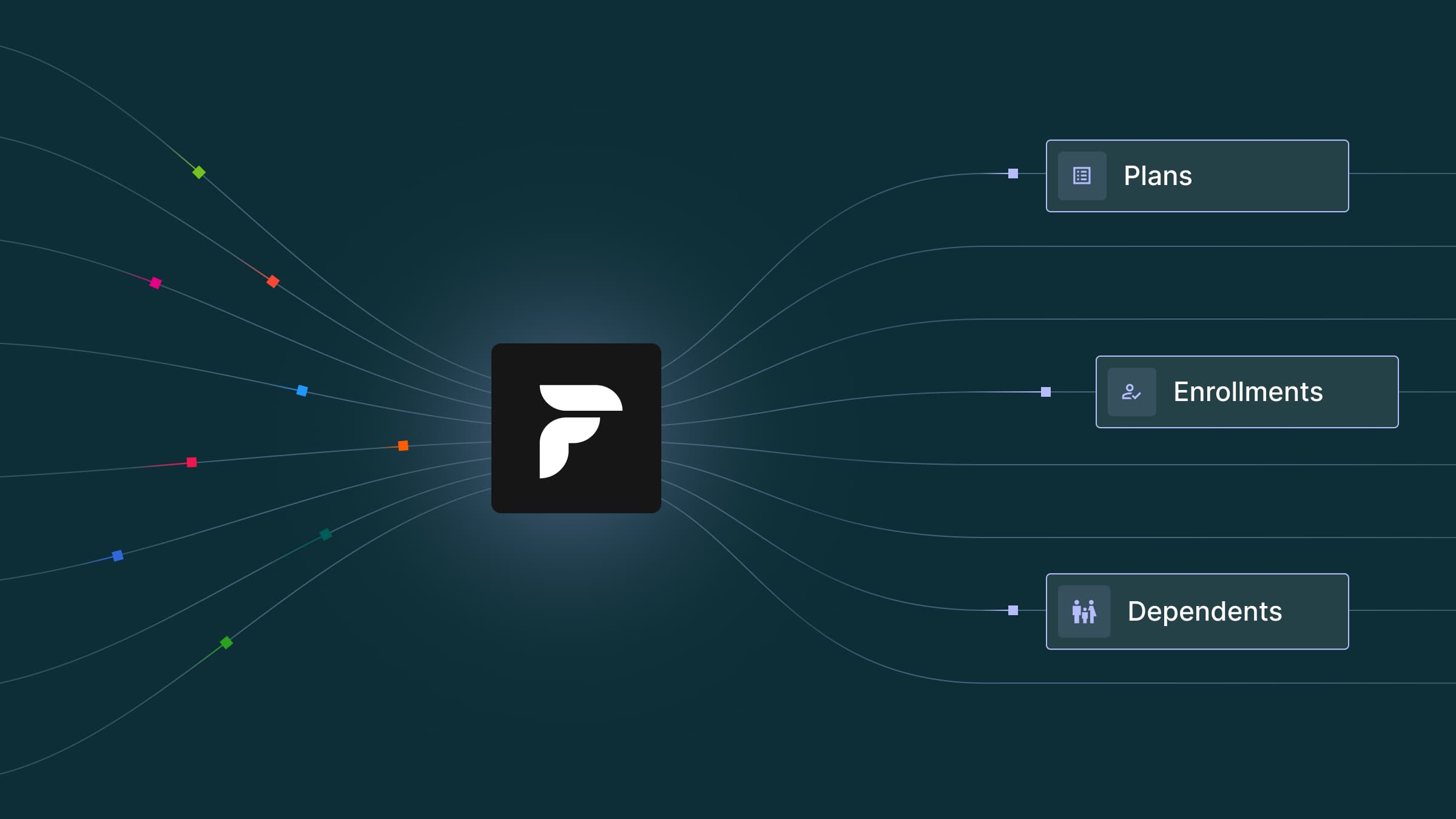
Instead of building and maintaining individual integrations with each provider, you build once against a single API. But the real value runs deeper: your product logic operates against a consistent schema, your data pipelines don't need provider-specific transformations, and your operations team sheds the burden of normalizing fields and maintaining mapping logic. The unified API handles that work once, at the platform level.
An opinionated model: Decisions made so you don't have to
Simply passing through raw data from different providers into a single endpoint is just aggregation. All the information may be there, but it’d be inconsistent, and the burden would just shift from accessing the data to making it actionable.
Finch's model is deliberately opinionated. We make choices about how to normalize values, what to expose, and when to abstract away provider-specific complexity, informed by deep research and validated against real customer use cases.
The FLSA example illustrates this: most customers only need a binary signal, exempt or not. A wider enum would add more noise than value, so we kept it narrow: EXEMPT, NON_EXEMPT, UNKNOWN, and NULL. That's what "opinionated" means in practice: doing the research and making domain-specific decisions so customers don't have to. And for those who need raw provider-specific data, request forwarding is always available.
Future-proofing for an AI-driven world
AI models are only as good as the data they operate on. Inconsistent field names, missing values, unstandardized formats, and provider-specific quirks fundamentally degrade the performance of any AI system or agent built on top of that data. The investment in a unified data model pays compounding dividends as AI use cases mature, because every improvement to data quality and consistency improves the performance of every AI application built on top of it.
This is why we think about data unification as a core tenet of our infrastructure, and a foundational requirement to power the AI and agentic transformations our customers are implementing in their products. The companies building on Finch today are laying the groundwork for AI-powered capabilities they'll ship tomorrow. And the quality of that foundation will determine how far and how fast they can go.
Build vs. buy — and why your engineers' time is better spent elsewhere
If you've read this far, you have a sense of the scale of work involved in building and maintaining payroll integrations. The question isn’t whether your team is capable, but whether it’s a worthwhile investment when there’s an alternative.
Maintaining payroll integrations isn't a one-time project. It’s an ongoing program that demands continuous oversight. Provider APIs change, auth flows break, data quality and connection health need continuous monitoring, and every additional provider compounds on that effort.
At Finch, we've made this our core investment. We have dedicated teams for connections, data quality, and platform reliability. We monitor SLOs across every surface area of the product. We've built the tooling, the operational processes, and the domain expertise to do this work at scale, across 250+ providers.
The build-vs.-buy decision comes down to your priorities. Every engineer you put on integration maintenance is an engineer not working on the features that make your product unique; every operations resource you dedicate to normalizing data feeds is a resource not spent on serving your customers. A unified API lets you redirect that investment toward what actually differentiates your business, while the integration infrastructure keeps running reliably underneath.
Want to see how Finch's unified API works? Explore our docs or talk to our team.

97% of HR professionals say it’s important for your app to integrate with their employment systems
Learn more in our State of Employment Technology report ->
97% of HR professionals say it’s important for your app to integrate with their employment systems

Payroll Integrations Made for Retirement